More than half of all homes sold last year and in 2013, so far, have been purchased mortgage-free, according to economists at Goldman Sachs Group. Prior to the housing crash, about 20 percent of all homes sold were purchased without financing. All-cash sales have more than doubled over the last seven years.
“The surprisingly large cash-share of purchases helps to explain why home sales have jumped over the past two years despite more muted increases in broad measures of new mortgage activity, such as the MBA’s mortgage application index,” The Wall Street Journal reports.
The large share of cash buys are most likely from investors, foreign buyers, and wealthy home owners, the report notes.
The Goldman report estimated that around 44 cents of every one dollar of homes sold presently are being financed with a mortgage. Prior to the housing crisis, that stood at 67 cents of every dollar.
The Goldman Sachs analysts used data from the National Association of REALTORS®, Census Bureau, Mortgage Bankers Association, and Lender Processing Services to arrive at their calculations.
Source: Realtor Mag // “Half of All Homes Are Being Purchased With Cash,” Wall Street Journal (Aug. 15, 2013)
Showing posts with label Chino Hills Realtor. Show all posts
Showing posts with label Chino Hills Realtor. Show all posts
Tuesday, August 20, 2013

Wednesday, August 14, 2013
Housing Recovery Taking Hold, but Income Growth Still a Concern
During a Bipartisan Policy Center forum Tuesday, experts generally agreed the housing market is on the path to recovery, but the strength of the national recovery remained in question.
Source: DS News, 8/13/2013
According to Douglas G. Duncan, chief economist at Fannie Mae, we may be in a recovery, but it has been the “weakest recovery since World War II” when considering income growth.
Richard Smith, CEO and president of Realogy, took a more optimistic approach and stated we are in the early stages of a “fairly strong recovery,” with prices reacting to inadequate supply.
Even if the recovery is happening, Paul Weech, EVP for policy and external affairs at the Housing Partnership Network, stated he does not want to see policy makers take their foot off the gas just yet since work still needs to be done.
An area of concern the panel addressed included the difficulty in obtaining housing when considering weak income growth and lending restrictions.
Richard Smith, CEO and president of Realogy, took a more optimistic approach and stated we are in the early stages of a “fairly strong recovery,” with prices reacting to inadequate supply.
Even if the recovery is happening, Paul Weech, EVP for policy and external affairs at the Housing Partnership Network, stated he does not want to see policy makers take their foot off the gas just yet since work still needs to be done.
An area of concern the panel addressed included the difficulty in obtaining housing when considering weak income growth and lending restrictions.
According to the Bureau of Labor Statistics, the unemployment rate fell to 7.4 percent in July, but average hourly earnings and average weekly hours worked also decreased.
However, Smith pointed out that the housing market is still managing a recovery in spite of the fact that lenders don’t know all the rules (such as the still undefined QRM rule) and income growth is limited. Adding to that is the unemployment rate, which is actually closer to 15 percent when considering the underemployed, Smith stated.
“Given a little nudge from regulators and Congress, I think housing will become even stronger than it is now,” he added.
Although rising mortgage rates might cause some potential buyers to reconsider the option of pursuing homeownership, panelists generally agreed rates aren’t the biggest threat in comparison to strict underwriting standards and weak incomes.
The panelists tended to agree that housing is still a good investment.
Kent Conine, owner of Conine Residential Group, described a home as one of the largest assets one will typically ever own, adding that a home is also “supposed” to appreciate.
Even with the recent spike in mortgage interest rates, Smith noted buyers are still purchasing an undervalued asset with cheap money.
In fact, the National Association of Realtors’ (NAR) housing affordability index showed housing is still very affordable. In the second quarter, the index stood at 175.4. An index reading of 100 is defined as the point where a median-income household has exactly enough income to buy a median-priced home.However, Smith pointed out that the housing market is still managing a recovery in spite of the fact that lenders don’t know all the rules (such as the still undefined QRM rule) and income growth is limited. Adding to that is the unemployment rate, which is actually closer to 15 percent when considering the underemployed, Smith stated.
“Given a little nudge from regulators and Congress, I think housing will become even stronger than it is now,” he added.
Although rising mortgage rates might cause some potential buyers to reconsider the option of pursuing homeownership, panelists generally agreed rates aren’t the biggest threat in comparison to strict underwriting standards and weak incomes.
The panelists tended to agree that housing is still a good investment.
Kent Conine, owner of Conine Residential Group, described a home as one of the largest assets one will typically ever own, adding that a home is also “supposed” to appreciate.
Even with the recent spike in mortgage interest rates, Smith noted buyers are still purchasing an undervalued asset with cheap money.
Source: DS News, 8/13/2013
Sunday, August 11, 2013
2013 Survey Shows Improved Perception of Housing Market
NAR’s tenth Housing Pulse Survey shows a stronger environment for home sales and home ownership and less concern about jobs and foreclosures than in 2011. While economic uncertainties remain, it’s clear that Americans are more upbeat about real estate sales and home ownership.
The survey, which measures consumers’ attitudes and concerns about affordable housing issues, found that people overwhelmingly believe that buying a home is a good financial decision. Further, home ownership remains one of the top life priorities for people who currently rent.
The telephone survey of 2,000 adults nationwide was conducted for NAR by American strategies and Myers Research & Strategic Services for NAR”s Housing Opportunity Program.
Some key findings from the year’s survey include:
The survey, which measures consumers’ attitudes and concerns about affordable housing issues, found that people overwhelmingly believe that buying a home is a good financial decision. Further, home ownership remains one of the top life priorities for people who currently rent.
The telephone survey of 2,000 adults nationwide was conducted for NAR by American strategies and Myers Research & Strategic Services for NAR”s Housing Opportunity Program.
Some key findings from the year’s survey include:
- Eight-in-ten Americans believe buying a home is a good financial decision, up 8 points since 2011.
- Half of renters now say that eventually owning a home is one of their highest personal priorities, up 9 points from 2011.
- Respondents expect to see continued improvement, as 37 percent expect real estate sales to increase in the year ahead.
Source: National Association of Realtors
Saturday, August 10, 2013
Closing Costs Rise 6% Over Last Year
Mortgage closing costs are up 6 percent over the past year, according to a report from Bankrate.com.
The average closing cost across the United States rose over the year to $2,402. Origination fees increased 8 percent to $1,730—accounting for the bulk of the increase in closing costs—while third-party fees rose 1 percent to $672.
In terms of highest average closing costs, Hawaii took the top spot with an average of $2,919. It was joined in the top five by Alaska ($2,675), South Carolina ($2,658), California ($2,639), and New Mexico ($2,566).
To find its results, Bankrate surveyed up to 10 lenders in all 50 states as well as the District of Columbia. Costs involved include fees charged by lenders and third-party fees for services such as appraisals; they exclude taxes, title fees, property insurance, association fees, interest, and other prepaid items.
Source: DS News
The average closing cost across the United States rose over the year to $2,402. Origination fees increased 8 percent to $1,730—accounting for the bulk of the increase in closing costs—while third-party fees rose 1 percent to $672.
In terms of highest average closing costs, Hawaii took the top spot with an average of $2,919. It was joined in the top five by Alaska ($2,675), South Carolina ($2,658), California ($2,639), and New Mexico ($2,566).
To find its results, Bankrate surveyed up to 10 lenders in all 50 states as well as the District of Columbia. Costs involved include fees charged by lenders and third-party fees for services such as appraisals; they exclude taxes, title fees, property insurance, association fees, interest, and other prepaid items.
Source: DS News
Friday, August 9, 2013
MBA: Delinquencies, Foreclosures Recede to More 'Normal' Levels
The percentage of homeowners behind on their mortgage fell to the lowest level since 2008, with a decrease in 90-plus delinquencies driving the improvement, according to a report from the Mortgage Bankers Association (MBA).
On a seasonally adjusted basis, the national mortgage delinquency rate on one-to-four unit residences stood at 6.96 percent in the second quarter, a decrease from 7.25 percent in the first quarter and 7.58 percent a year ago. "For most of the country, delinquencies and foreclosures have returned to more normal historical levels," said Jay Brinkmann, MBA's chief economist and SVP of research and economics.
Source: DS Newa
Thursday, August 1, 2013
Foreclosures Rise in June, But See Big Drop for Year
-(See my July 11th posting which highlights falling foreclosures for May)-
Completed foreclosures rose 2.5 percent in June from May, CoreLogic reported Tuesday. Its report follows another recent one from Lending Processing Services that showed nearly a 10 percent rise in the national delinquency rate in June compared to May.
About 1 million homes are in the foreclosure inventory as of June, CoreLogic reports. That does mark a 28 percent decrease in the foreclosure inventory compared to last year.
Forty-nine states reported a year-over-year decline in foreclosure rates in June.
"The housing market is clearly on the mend, but we expect the ultimate conclusion of the present housing down cycle to be another several years away,” says Anand Nallathambi, president and CEO of CoreLogic.
CoreLogic reports the five states with the largest foreclosure inventories -- as a percentage of mortgaged homes -- in June were:
- Florida: 8.6%
- New Jersey: 6%
- New York: 4.8%
- Connecticut: 4.2%
- Maine: 4.1%
Wednesday, July 31, 2013
Is Home Ownership Becoming Too Exclusive?
The home ownership rate dipped to 65.1 percent in the second quarter, falling to the lowest level since the fourth quarter of 1995, the Census Bureau reported Tuesday. The drop coincides with efforts by consumer groups and lawmakers to try to make home ownership more inclusive, particularly at a time when affordability is still high.
In 2004, the U.S. home ownership rate soared to a record 69.2 percent. But the home ownership rate will likely reach bottom at about 64 percent in the next year due to the high number of foreclosures in the pipeline and rise in rental homes, Capital Economics Inc. analysts predict.
Meanwhile, lawmakers and consumer groups are trying to make home ownership more within reach to more families.
For example, “regulators are close to proposing a softened version of a rule requiring banks to keep a stake in risky mortgages they securitize,” Bloomberg reports. “Lawmakers currently shaping housing finance are seeking to reduce the government's role in keeping rates affordable for riskier borrowers while ensuring home ownership is within reach of minorities and first-time buyers who could be needed to sustain the housing recovery as borrowing costs rise from record lows.”
First-time buyers and minorities have seen some of the largest declines in home ownership rates. For example, the home ownership rate for blacks dropped to 42.9 percent in the second quarter of this year, compared with nearly 50 percent in the second quarter of 2004. Meanwhile, first-time buyers -- who are often in their 20s or early 30s -- have been at a disadvantage because of limited assets to come up with down payments and trying to meet tighter underwriting standards.
While the industry wants to encourage home ownership, it is moving cautiously to avoid repeating past mistakes, in which exotic adjustable rate mortgages and low down payments fueled a large housing bubble that eventually caused about 7 million people to lose their homes to foreclosure.
Source: “Homeownership Rate at Its Lowest Since 1995,” Reuters (July 30, 2013) and “Efforts under way to boost low home ownership rate,” Bloomberg News (July 30, 2013)
In 2004, the U.S. home ownership rate soared to a record 69.2 percent. But the home ownership rate will likely reach bottom at about 64 percent in the next year due to the high number of foreclosures in the pipeline and rise in rental homes, Capital Economics Inc. analysts predict.
Meanwhile, lawmakers and consumer groups are trying to make home ownership more within reach to more families.
For example, “regulators are close to proposing a softened version of a rule requiring banks to keep a stake in risky mortgages they securitize,” Bloomberg reports. “Lawmakers currently shaping housing finance are seeking to reduce the government's role in keeping rates affordable for riskier borrowers while ensuring home ownership is within reach of minorities and first-time buyers who could be needed to sustain the housing recovery as borrowing costs rise from record lows.”
First-time buyers and minorities have seen some of the largest declines in home ownership rates. For example, the home ownership rate for blacks dropped to 42.9 percent in the second quarter of this year, compared with nearly 50 percent in the second quarter of 2004. Meanwhile, first-time buyers -- who are often in their 20s or early 30s -- have been at a disadvantage because of limited assets to come up with down payments and trying to meet tighter underwriting standards.
While the industry wants to encourage home ownership, it is moving cautiously to avoid repeating past mistakes, in which exotic adjustable rate mortgages and low down payments fueled a large housing bubble that eventually caused about 7 million people to lose their homes to foreclosure.
Source: “Homeownership Rate at Its Lowest Since 1995,” Reuters (July 30, 2013) and “Efforts under way to boost low home ownership rate,” Bloomberg News (July 30, 2013)
Monday, July 29, 2013
Report: 26% of HAMP Borrowers Redefaulted, Rate Continues to Worsen
Upon closer
examination, the Home Affordable Modification Program (HAMP) has not helped as
many borrowers as it may seem, according to a report from Special Inspector General for the Troubled Asset Relief Program (SIGTARP).
HAMP, a government loan modification program created to prevent foreclosures, has provided about 1.2 million modifications to distressed borrowers since its inception in 2009.
Of those borrowers, 306,538 redefaulted after falling behind on their payments by three months, which means in actuality, 865,100 are still actively in the program, the taxpayer watchdog agency revealed.
Of the redefaulters, 22 percent have entered into the foreclosure process.
Source: DSNews 07/24/2013
HAMP, a government loan modification program created to prevent foreclosures, has provided about 1.2 million modifications to distressed borrowers since its inception in 2009.
Of those borrowers, 306,538 redefaulted after falling behind on their payments by three months, which means in actuality, 865,100 are still actively in the program, the taxpayer watchdog agency revealed.
Of the redefaulters, 22 percent have entered into the foreclosure process.
On the other hand, homeowners who received modifications in early 2013 have a redefault rate of less than 1 percent.
The report also found states with a smaller numbers of HAMP borrowers tended to have higher redefault rates. Mississippi, which has provided just over 4,500 HAMP modifications, has a redefault rate of 35 percent, the highest out of any other state.
Based on region, Western states averaged the lowest default rate of 21 percent and had the highest number of permanent modifications as group.
The report also found states with a smaller numbers of HAMP borrowers tended to have higher redefault rates. Mississippi, which has provided just over 4,500 HAMP modifications, has a redefault rate of 35 percent, the highest out of any other state.
Based on region, Western states averaged the lowest default rate of 21 percent and had the highest number of permanent modifications as group.
Source: DSNews 07/24/2013
Sunday, July 28, 2013
Margin Loans Help Buyers Close Deals
Margin loans for short-term financing can help potential home buyers get cash fast to close a deal or win a bidding war — and an increasing number of people are turning to them for a quick fix.
"A person with easy access to cash may have a leg up over someone who has to have long-term financing," explains Tucker Watkins, a private wealth adviser with wealth-management company Ameriprise Financial Inc.
The product offers some pricing benefits, as there are no closing costs, no property appraisal is required, there are no prepayment penalties, and borrowers do not have to make monthly interest payments. There also are tax benefits to consider, given that interest on a margin loan generally is tax-deductible. On the other hand, a buyer who cashes out stocks to make a down payment may have to pay capital-gains taxes.
"Avoiding capital gains is often a reason why someone may use a margin loan instead of selling a security," says Watkins.
Source: RealtorMag // "For Faster Cash, Buyers Live on the Margin," The Wall Street Journal (July 19, 2013)
"A person with easy access to cash may have a leg up over someone who has to have long-term financing," explains Tucker Watkins, a private wealth adviser with wealth-management company Ameriprise Financial Inc.
The product offers some pricing benefits, as there are no closing costs, no property appraisal is required, there are no prepayment penalties, and borrowers do not have to make monthly interest payments. There also are tax benefits to consider, given that interest on a margin loan generally is tax-deductible. On the other hand, a buyer who cashes out stocks to make a down payment may have to pay capital-gains taxes.
"Avoiding capital gains is often a reason why someone may use a margin loan instead of selling a security," says Watkins.
Source: RealtorMag // "For Faster Cash, Buyers Live on the Margin," The Wall Street Journal (July 19, 2013)
Saturday, July 27, 2013
Fannie: Fast Rise in Mortgage Rates Could Hurt
The rise in mortgage rates over the last couple of months has been “significant” and could hamper the housing recovery, economists note in Fannie Mae’s Economic Strategic Report for July. However, home sales so far have been little affected by the spikes, they say.
The 30-year fixed-rate mortgage has risen more than 110 basis points from the first week of May to the end of June. In early July, it started to ease somewhat. Still, the report says that despite the increases, rates are still near historical lows. It’s the sudden rise in such a short time that has been alarming, the economists note.
Mortgage applications for home purchases have fallen about 9 percent since early May, when the rise in rates began. However, pending home sales during that same period rose to the highest level in more than six years. Many of those sales, though, are in cash, which means they may be less tied to the rise in mortgage rates.
Fannie Mae economists predict that mortgage rates will continue a gradual rise and average 4.7 percent in the fourth quarter. That is about 40 basis points higher than economists had predicted a month ago.
Economists predict home sales will rise about 8 percent in 2013, and the median home price will be $189,000 for existing homes and $276,000 for new homes in the fourth quarter.
Source: RealtorMag // “Fannie Mae Expects Rates to Continue Higher,” Mortgage News Daily (July 22, 2013)
The 30-year fixed-rate mortgage has risen more than 110 basis points from the first week of May to the end of June. In early July, it started to ease somewhat. Still, the report says that despite the increases, rates are still near historical lows. It’s the sudden rise in such a short time that has been alarming, the economists note.
Mortgage applications for home purchases have fallen about 9 percent since early May, when the rise in rates began. However, pending home sales during that same period rose to the highest level in more than six years. Many of those sales, though, are in cash, which means they may be less tied to the rise in mortgage rates.
Fannie Mae economists predict that mortgage rates will continue a gradual rise and average 4.7 percent in the fourth quarter. That is about 40 basis points higher than economists had predicted a month ago.
Economists predict home sales will rise about 8 percent in 2013, and the median home price will be $189,000 for existing homes and $276,000 for new homes in the fourth quarter.
Source: RealtorMag // “Fannie Mae Expects Rates to Continue Higher,” Mortgage News Daily (July 22, 2013)
Friday, July 26, 2013
What To Expect From Housing In The Second Half Of 2013
The U.S. housing recovery continues to make gains.
New home sales have surged 38% since last year, hitting a five-year high in June, according to the newest figures from the Commerce Department. And despite a monthly drop in activity, sales of previously owned homes remain 15% higher than last year as well, according to the National Association of Realtors.
Source: Forbes 7.26.2013
New home sales have surged 38% since last year, hitting a five-year high in June, according to the newest figures from the Commerce Department. And despite a monthly drop in activity, sales of previously owned homes remain 15% higher than last year as well, according to the National Association of Realtors.
If housing in the first six months of 2013 could be summed up in one sentence, it would go something like this: Inventory is painfully tight, sales activity is surging and home prices have jumping.
Now real estate experts are sounding off on the trends that will help shape the sector in the second half of 2013. Here’s what you need to know.
We Are Not Re-inflating A Bubble
Home prices have clocked double-digit price appreciation this year. Prices across the 20 major U.S. metro markets were 12% higher in April than they were a year before, according to the S&P/Case-Shiller Home Price Index. Other indexes have registered similarly dramatic gains. The last time prices appreciated by double digits were during the last housing bubble, motivating to question whether a new bubble is beginning to inflate.
It isn’t. The current pace of growth, while certainly unsustainable for long term market health, is nothing to worry about just yet. “Prices are now rising as fast as they were during the bubble years, but they are still low relative to the levels where they were back then,” explains Jed Kolko, chief economist of Trulia , a San Francisco, Calif.-based real estate site.
He says prices are actually undervalued across most of the country, lower not just than their bubble-era peaks but also lower than their historical norms when adjusted for inflation.
“You can sort of think of it as we overshot on the way down and this is sort of a correction back to something more normal,” adds Mark Fleming, chief economist of CoreLogic, an Irvine, Calif.-based real estate data firm.
Economists do believe home prices will continue to climb throughout the rest of this year. CoreLogic projects 2013 will end with a 6% increase over 2012. And Altos Research, a Mountain View, Calif.-based firm that tracks real estate data in real time, believes 2013’s final tally will be even higher. “Based on the actual supply and demand data, we are looking at 12% year-over-year,” says Michael Simonsen, chief executive of Altos Research.
Still, it won’t last. They say several variables, including increased inventory and higher mortgage rates, will slow the pace growth, which to be clear, is expected to stay positive over the next several years.
More Homes Coming To Market
I’ve said it before. The abnormally tight inventory levels fueling the return of such frothy buyer practices as bidding wars and contingency-free offers will slowly begin to ease. Inventory – which hit a 12-year low earlier this year — is already starting to increase and economists believe that trend will continue despite the season.
In June, there were 7% less home for sale than a year earlier, according to Realtor.com, but the monthly numbers offer the forward-looking story. From May to June, inventory grew by 4%; last year that monthly increase was only 1%.
“We think inventory levels on a year-over-year basis will probably flatten out by the end of this year. That will be the first time since 2007,” says Errol Samuelson, president of Realtor.com. “I think you are actually going to see inventory growth on a year-on-year basis starting in the fall, but prices nonetheless will continue to appreciate.”
“Inventory started to expand very slowly maybe about four months ago,” echoes Kolko. “We will see that continue as rising prices help owners get back above water and help other sellers decide to take advantage of price appreciation.”
Still, some experts, like Simonsen, believe we could see housing shortages in the most sought after locales as far out as the next three years.
It will come down to new construction as more homebuilders continue to gain confidence and roll new developments. Kolko expects to see more construction commence in places like Texas, the Carolinas, Northern California and other parts of country where there’s strong housing demand, spurring job growth in both construction and housing-related industries.
Since an unusually large portion of new construction is multifamily, increased inventory won’t just help slow the rapid rate of home price growth but also quell rent prices. As many as six million more households will join the rental market ranks over the next decade, according to the National Association of Realtors; more building in major cities will help keep rents from rising too much in response.
Mortgage Rates Will Keep Climbing
Mortgage rates have risen over the past two months. A recent Trulia survey found rising rates was the number one worry among prospective buyers right now.
Economists believe rates will continue to climb, though at a much less feverish pace than recently witnessed. But while the higher rates – the 30-year fixed loan is about a point higher than it was in early May – mean borrowing is getting more expensive, housing won’t become unaffordable anytime soon.
“Prices are still low relative to rents, so at 4.5%, it’s still more than a third cheaper to buy than to rent on average across the U.S.,” notes Kolko. “Not every market will remain cheaper to buy but on average… buying will stay cheaper than renting until rates reach 10.5% — a level we haven’t seen since 1990.”
Still, in metro areas like San Francisco, San Jose, New York and Honolulu, markets that were always historically cheaper to rent than buy before the downturn, rates will begin to tip the scale back toward renting once they rise above 5%.
“Our estimation is it would take a 6.5% interest rate to bring affordability just back up to the level of early 2000s, [meaning] neither too affordable nor unaffordable,” adds CoreLogic’s Fleming. “There’s plenty of room for appreciation and rate increases before that and we will probably get a little of both.”
Rising rates may help fuel another trend in the coming months: an easing of tight mortgage credit that has hampered the purchases of even qualified homebuyers. As rates rise, refinancing business dries up, pushing lenders to begin ramping up the mortgages they underwrite for prospective buyers.
Distressed Decline
Foreclosure activity is on the decline. RealtyTrac, an Irvine, Calif.-based foreclosure site, reports that 800,000 properties had foreclosure filings on them nationwide in the first half of 2013. That’s down 19% from the second half of 2012 and down 23% from the six months before that. In June there were 127,000 filings across the U.S. – the lowest number logged since December 2006.
“On a nationwide basis we will continue to see the numbers go down,” projects Daren Blomquist, vice president of RealtyTrac. “We will still have the flare-ups in state and local markets…but nothing that is going to overwhelm the momentum we have in the market right now.”
He says the exceptions to that downward trend will continue to be states where foreclosures undergo a judicial process. Florida, New York, New Jersey, Illinois, and Maryland has all seen increases in activity this year, in part because lenders are finally dealing with distressed inventory that had been delayed. Another market that may experience a “last gasp” of foreclosures is California, since the state’s Homeowner Bill of Rights has slowed down the foreclosure process.
Short sales continue to increase, with lenders arranging deals before they even process their first foreclosure filing on a delinquent homeowner’s property. In the first quarter of 2013 short sales increased 79% versus a year earlier, thanks in part to the fact that short sale guidelines were loosened by the government sponsored enterprises.
Another trend that will continue: investor activity, especially among institutions. Institutional investors funded by Wall Street capital have been buying up distressed single family homes and converting them into rentals. According to RealtyTrac’s data, which defines institutional investors as entities that have purchased 10 or more properties in the past year, purchases have continued to increase, with southeastern markets like Florida and Georgia logging 200%-plus yearly increases.
“The one big pool of risk is the underwater homeowners,” says Daren Blomquist, vice president of RealtyTrac, an Irvine, Calif.-based foreclosure site. He estimates that there are as many as 11.3 million borrowers holding mortgage notes worth more than their homes. “It’s going to take two or three years before they actually have equity in their homes. Until we have those people in a place where they can participate in the market, there will be a slight drag on the housing market.”
Source: Forbes 7.26.2013
10 Metros Where Rents Are Soaring
Investors eager to pick up rental properties should be eyeing several metros, particularly out West, where rental rates have skyrocketed over the past year.
The San Francisco Bay Area has seen some of the largest rent hikes — an increase of 7.8 percent in the second quarter of this year compared to the same time period a year ago, according to Texas-based market-research firm MPF Research.
Of the top 50 U.S. metros with the highest average rent growth, the following areas have seen the biggest spikes, MPF found:
The San Francisco Bay Area has seen some of the largest rent hikes — an increase of 7.8 percent in the second quarter of this year compared to the same time period a year ago, according to Texas-based market-research firm MPF Research.
Of the top 50 U.S. metros with the highest average rent growth, the following areas have seen the biggest spikes, MPF found:
- San Francisco: 7.8%
- Oakland, Calif.: 6.9%
- Denver: 6.1%
- Seattle: 6%
- San Jose, Calif.: 5%
- Portland, Ore.: 4.4%
- Houston: 4.3%
- Austin, Texas: 4.1%
- West Palm Beach, Fla.: 4%
- Fort Worth, Texas: 3.6%
Thursday, July 25, 2013
2013 Spring Selling Season - Hottest Since 2004, As Recovery Accelerates & Widens

Overview
Zillow’s second quarter Real Estate Market Reports , released today, show home values increased 2.4% from the first quarter of 2013 to the second quarter of 2013 to $161,100. This quarter marks the largest annual gain since August 2006 and largest quarterly gain since the fourth quarter of 2005. On an annual basis, the Zillow Home Value Index (ZHVI) rose 5.8% from June 2012 levels.Monthly appreciation remains strong with national home values growing by 0.9% from May. Not only did the pace of home value appreciation quicken in the second quarter, but the recovery also fully took hold nationwide. Markets in some areas of the Northeast, Midwest and Southeastern U.S., such as Atlanta, Chicago and St. Louis, that had previously been slow to turn the corner began to appreciate, which helped boost the overall national market.
All of the top 30 largest metro areas covered by Zillow experienced annual appreciation in home values as of the end of the second quarter, and all have hit their bottom.
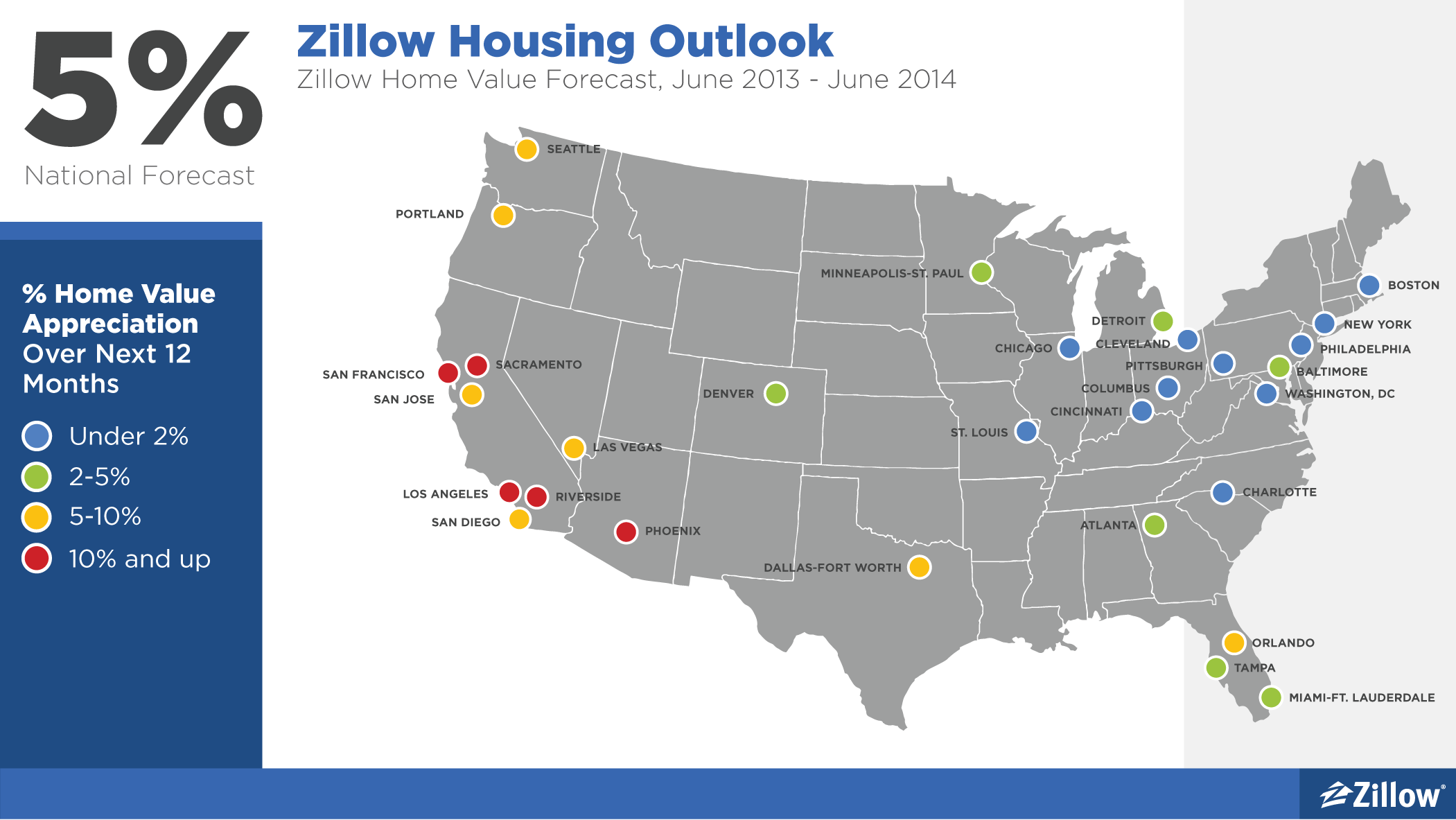
According to the Zillow Home Value Forecast, we expect national home values to increase 5% over the next year (June 2013 to June 2014). Of the 257 markets covered by the Zillow Home Value Forecast, 241 markets are expected to see increases in home values over the next year, with the largest increases expected in the Sacramento metro (18.9%) and the Riverside metro (16.6%).
Many California markets follow closely at the top of the list of markets expected to see the highest home value appreciation over the next year. According to the Zillow Home Value Forecast, 234 markets (91%) have already hit a bottom in home values, and another 13 are expected to hit a bottom by June 2014.
Home Values
The Zillow Real Estate Market Reports cover 389 metropolitan and micropolitan areas (metros) of which 259 showed quarterly home value appreciation. Three metros remained flat, while 127 metros show home values losses.Approximately 72% of the metros covered by the Real Estate Market Reports posted annual increases in home values – a sign of the national housing recovery continuing to take hold. Among the largest metros, Sacramento showed the largest annual increase with home values rising 29.5% from the second quarter of 2012 to the second quarter of 2013.
We do believe that appreciation rates will return to more sustainable levels over the next year or two. Overall, national home values are back to August 2004 levels, down 17.2% since their peak in May 2007. A table of the top 30 metros can be found at the end of this report.
Rents
The Zillow Rent Index (ZRI) covers 496 metro areas, and 57% of those metros reported annual increases in rents in June. As a point of comparison, nearly 72% of the metro areas covered by the ZHVI experienced annual home value increases. Nationally, rents increased 1.6% in June from year-ago levels, denoting a slowing. This is a significant annual decline in the rental appreciation rate from its peak appreciation of 6.2% nationally in September 2012. This development combined with rising home values is another contributor to investors exiting some markets as they had often bought for-sale inventory to convert them to for-rent properties. Markets that continue to see extremely strong year-over-year rent increases include Cincinnati (10.5%), Denver (5.5%) and Boston (4.3%).Foreclosures
The rate of homes foreclosed continued to decline in June with 4.96 out of every 10,000 homes in the country being liquidated through foreclosure. Nationally, foreclosure resales remain low, making up 9.53% of all sales in June, down 3.6 percentage points from the second quarter of 2012, underlining the limited inventory of foreclosure resales. For-sale inventory levels remain constrained, with manymetro areas across the country having fewer for-sale listings available in June compared with last year, although constraints are beginning to ease. The lack of foreclosure resales and normal for-sale inventory in many markets is contributing to home value appreciation. In the second half of the year we expect continued easing with investors starting to slowly exit markets as home values continue to climb.
Outlook
With the housing recovery in full force, many homeowners are feeling a sense of whiplash after years of depreciation, but this kind of market behavior won’t last. Investors are starting to pull out of some markets – as home values are climbing higher – and regular buyers are coming back, now that they can be competitive again. Although, some consumers are starting to feel the decrease in purchasing power due to higher mortgage rates.More for-sale inventory is slowly but surely coming on line, as homes are freed from negative equity and more homeowners are deciding to sell. Both of these developments will contribute to slowdowns in appreciation toward more sustainable rates.
In some overheated markets, rapid home value increases coupled with rising mortgage rates will lead to housing prices and financing costs outpacing local income growth, which will also contribute to a moderation of the market.
The U.S. housing market as a whole is currently not experiencing a bubble, but in many places it may feel like one, with some markets (Sacramento, Las Vegas, San Francisco) experiencing annual home value appreciation approaching 30 percent.
Source: Zillow Real Estate Research
Wednesday, July 24, 2013
U.S. House Prices Climbed 7.3% in Year Through May

U.S. house prices rose 7.3 percent in the year through May as buyers competed for a small supply of listings, according to the Federal Housing Finance Agency.
Prices increased 0.7
percent on a seasonally adjusted basis from April, the FHFA said in a report
today from Washington. The average economist estimate was for a 0.8
percent gain, according to data compiled by Bloomberg.
Real estate values are climbing as improving employment helps
draw buyers into the market for a tight inventory of homes. A separate report
today from Zillow Inc. (Z) showed
U.S. home values rose 2.4 percent in the second quarter from the previous three
months. It was the biggest gain for a second quarter since 2004.
“The U.S. housing market as a whole is currently not experiencing a bubble, but
in many places it sure must feel like one,” Zillow Senior Economist Svenja
Gudell said in a statement. “Homeowners are feeling a sense of whiplash after
years of depreciation.”
The limited supply and
higher mortgage rates may be restraining purchases. Sales of previously owned homes unexpectedly slipped 1.2 percent in
June to 5.08 million annualized rate, the National Association of Realtors
reported yesterday. The number of properties on the market last was month was
the fewest for any June since 2001.
Market ‘Excitement’
The average rate for a 30-year fixed loan was 4.37 percent last week, up from a near-record low of 3.35 percent in May, according to Freddie Mac.“Our inventory is incredibly low right now,” Margaret Kelly, chief executive officer of Re/Max LLC, a Denver-based network of real estate agencies, said on Bloomberg Television’s “Market Makers” with Sara Eisen and Deirdre Bolton. “When you have low inventory, high demand, prices rise, you’ve got a lot of excitement in the market. I think once we see inventory rise a bit, you’re going to see some of those things calm down. It’ll be more of a normal market.”
The FHFA’s report showed prices
increased 15.8 percent from a year earlier in the Pacific area, which includes
California and Oregon. In the Mountain region, including Nevada and Arizona, the gain
was 12.7 percent. The East South Central area -- including Kentucky and Alabama -- had
the smallest increase, at 2.7 percent.
The FHFA index measures
transactions for single-family properties financed with mortgages owned or
securitized by Fannie Mae and Freddie
Mac. The gauge is 11.2 percent below its April 2007 peak.
Source: Bloomberg
Source: Bloomberg
Wednesday, July 10, 2013
Will Rising Mortgage Rates Cool the Market?
A big jump in mortgage rates over the past two months may start to cool the rapid rise of home prices in the second half of the year, The Wall Street Journal reports.
Mortgage rates have shot up from lows of 3.59 percent in the beginning of May, to 4.58 percent during the last week of June, according to the Mortgage Bankers Association. Rates are at their highest levels in two years.
“A rule of thumb holds that every one percentage point increase in interest rates reduces affordability by 10 percent, so the recent move in rates just made homes about 10 percent more expensive to buyers who need to finance their purchase,” The Wall Street Journal reports.
Still, economists say mortgage rates at 4.5 percent or 5 percent is still very affordable by historical standards. Merrill Lynch analysts say that home prices would have to rise by 20 percent or mortgage rates would have to soar to around 6 percent to chip away at housing’s affordability.
Some economists see rising mortgage rates as a positive. John Burns, chief executive of John Burns Real Estate Consulting, says that rising rates produce more sustainable price increases. “I don’t think it’s the end of price increases, but I think they’re going to moderate significantly,” Burns told The Wall Street Journal.
Source: “Why Home-Price Gains Will Slow Amid Higher Mortgage Rates,” The Wall Street Journal
Mortgage rates have shot up from lows of 3.59 percent in the beginning of May, to 4.58 percent during the last week of June, according to the Mortgage Bankers Association. Rates are at their highest levels in two years.
“A rule of thumb holds that every one percentage point increase in interest rates reduces affordability by 10 percent, so the recent move in rates just made homes about 10 percent more expensive to buyers who need to finance their purchase,” The Wall Street Journal reports.
Still, economists say mortgage rates at 4.5 percent or 5 percent is still very affordable by historical standards. Merrill Lynch analysts say that home prices would have to rise by 20 percent or mortgage rates would have to soar to around 6 percent to chip away at housing’s affordability.
Some economists see rising mortgage rates as a positive. John Burns, chief executive of John Burns Real Estate Consulting, says that rising rates produce more sustainable price increases. “I don’t think it’s the end of price increases, but I think they’re going to moderate significantly,” Burns told The Wall Street Journal.
Source: “Why Home-Price Gains Will Slow Amid Higher Mortgage Rates,” The Wall Street Journal
Wednesday, June 12, 2013
Relocating & Need A Realtor? Call Howard Curry 714-323-1233
At no cost to you, I can find you a Realtor to assist you when you relocate to San Diego, Northern California or almost anywhere in the U.S.
Century 21 is partnered with the largest relocation network in the U.S. & assists many Fortune 500 companies in relocation. Whether the agent works with Century 21, Coldwell-Banker, Sotheby's or another Realty firm, we will find you a premiere Realtor in your new city to work with you in your real estate needs. Yes, at no cost to you!
Call Howard Curry at 714-323-1233 for more information or visit http://chinohillsresidentialhomes.com/
Century 21 is partnered with the largest relocation network in the U.S. & assists many Fortune 500 companies in relocation. Whether the agent works with Century 21, Coldwell-Banker, Sotheby's or another Realty firm, we will find you a premiere Realtor in your new city to work with you in your real estate needs. Yes, at no cost to you!
Call Howard Curry at 714-323-1233 for more information or visit http://chinohillsresidentialhomes.com/
Tuesday, June 11, 2013
Thinking About Selling Your Home? I have Cash Buyers Looking For Homes in Chino Hills & Surrounding Commnities
If you are looking to sell your home in Chino Hills, Diamond Bar, Corona and surrounding communities, call Howard Curry at 714-323-1233 your Southern California premiere realtor at Century 21 Beachside Fine Home & Estates.
Monday, June 10, 2013
Closed Escrow Today in Chino Hills! Ready to Sell in the Inland Empire? Call Howard Curry
Closed escrow on my Chino HIlls listing today and in 30 days! I have cash & pre-approved buyers. If you want to close fast, call Howard Curry 714.323.1233 or visit http://chinohillsresidentialhomes.com/
Forces Driving Up Prices Are Temporary
Despite improvements in home values, Radar Logic continues to contend the factors underpinning the recovery will not lead to sustainable price gains.
In March, Radar Logic’s home price index, which tracks 25 metro areas, showed a 13.1 percent year-over-year gain.
Even with the double-digit gain, the data and analytics firm touched on several points to explain why the trend won’t last, with the main one being the temporary issue of limited supply.
To see the full article, go to http://www.dsnews.com/articles/index/report-forces-driving-up-prices-are-only-temporary-2013-06-03
In March, Radar Logic’s home price index, which tracks 25 metro areas, showed a 13.1 percent year-over-year gain.
Even with the double-digit gain, the data and analytics firm touched on several points to explain why the trend won’t last, with the main one being the temporary issue of limited supply.
To see the full article, go to http://www.dsnews.com/articles/index/report-forces-driving-up-prices-are-only-temporary-2013-06-03
Sunday, June 9, 2013
Asking Prices Accelerate in Least Affordable Housing Markets
Asking prices are rising at an especially fast pace in the least affordable housing markets, according to Trulia.
Nationally, asking prices increased 9.5 percent year-over-year in May, but in the ten least affordable metros, asking prices spiked 16.3 percent during the same time period.
Trulia also found out of the 100 largest metros, 98 saw asking prices increase over the last year.
Among the least affordable markets, seven were in California.
See the full article at http://www.dsnews.com/articles/trulia-asking-prices-accelerate-in-least-affordable-housing-markets-2013-06-07
Subscribe to:
Posts (Atom)